Westchester County is renowned for its stunning historic architecture, from Victorian estates to mid-century masterpieces. However, the very age that gives these homes their character also makes them susceptible to structural fatigue. Over decades, the soil composition in New York—rich in clay and subject to intense freeze-thaw cycles—exerts relentless pressure on masonry. Understanding the silent signals of a shifting base is the difference between a simple reinforcement and a catastrophic structural failure.
Why Historic New York Foundations Shift Over Time
Before identifying the symptoms, it is vital to understand the “why.” Most historic homes in our region rest on stone, brick, or early poured concrete foundations. Unlike modern reinforced structures, these materials are porous and move in response to the soil. In Westchester, our high water table leads to significant hydrostatic pressure. When the ground becomes saturated, the water pushes against your basement walls with thousands of pounds of force. Over a century, this leads to the “creep” of foundation materials that eventually manifests as visible damage.
1. Horizontal Cracks in Basement Walls
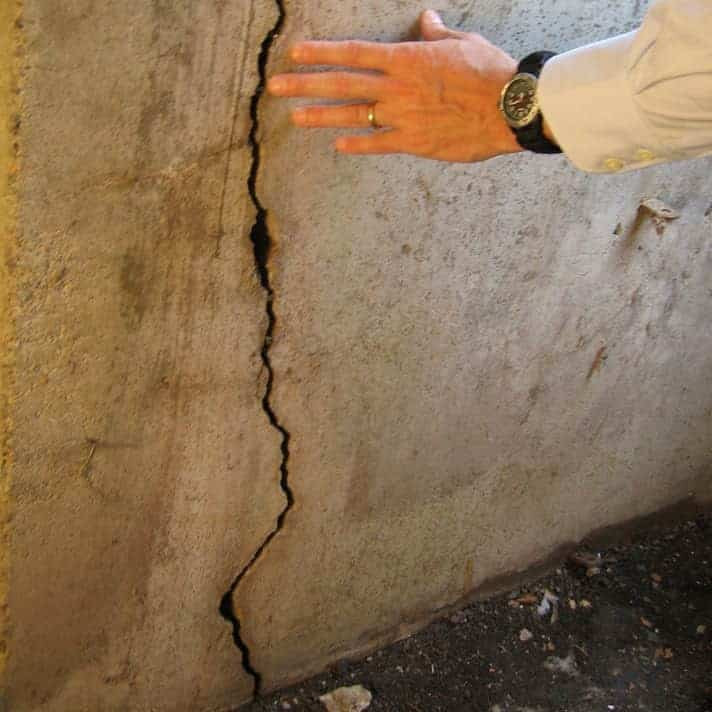
While small hairline vertical cracks are often just a sign of natural settling, horizontal cracks are a major red flag. If you notice a crack running horizontally across your basement or crawlspace wall, it typically indicates that hydrostatic pressure is forcing the wall inward. This is the first stage of a “bowed wall,” a condition that, if left unaddressed, can lead to a total wall collapse.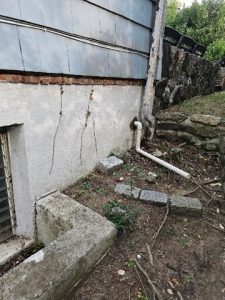
2. Sticking Doors and Windows
Homeowners often attribute sticking doors to humidity. However, if a door suddenly becomes difficult to latch or a window that used to slide easily is now jammed, the frame may no longer be square. This happens when one section of the foundation settles faster than the rest. In historic homes, this “differential settlement” can twist the entire wooden skeleton of the house.
3. Stair-Step Cracks in Exterior Brickwork
If your home has a brick or stone veneer, look at the mortar joints. Cracks that follow the pattern of the bricks in a “stair-step” fashion are classic indicators of foundation sinking. These cracks usually start near the corners of the home and widen as the settlement progresses, allowing moisture to penetrate your wall cavity.
4. Uneven or Sloping Floors
Have you noticed a gap between the baseboard and the floor? Or perhaps a marble rolls toward one side of the room? Sloping floors in older Westchester homes often point to failing support beams or a foundation that is dipping in one corner. While some “slump” is expected in 100-year-old homes, significant slopes indicate a loss of structural integrity.
5. Gaps Around the Chimney or Fascia
A chimney is often the heaviest part of a historic structure and rests on its own footing. If the chimney begins to pull away from the siding of the house, it is a clear sign that the soil underneath is no longer supporting the weight. Similarly, gaps appearing where the walls meet the ceiling or the roofline (fascia) suggest the house is literally pulling itself apart.
6. Displaced Moldings and Drywall Cracks
Keep an eye on the interior corners of your rooms. If you see cracks zig-zagging up the drywall, especially above door frames or where the wall meets the ceiling, the house is shifting. In historic homes with plaster walls, you may see large “bosses” or areas where the plaster is bubbling or falling away due to the stress of the movement.
 7. Inward Bowing of Foundation Walls
If you stand at one end of your basement and look down the length of the wall, it should be perfectly straight. If the middle of the wall appears to be leaning toward you, the wall is bowing. This is a critical failure. At Sundahl Restoration, we utilize advanced carbon fiber reinforcement to “lock” these walls in place, preventing further movement without the need for invasive excavation.
Permanent Solutions for Westchester Homeowners
The goal of foundation repair is not just to hide the cracks, but to stop the movement. At Sundahl Waterproofing Restoration, we specialize in high-integrity, non-invasive solutions. Whether it is utilizing carbon fiber strapping to reinforce bowed walls or precision epoxy injections to seal structural cracks, we focus on permanent stabilization. We don’t believe in high-pressure sales; we believe in engineering-backed solutions that protect your greatest investment.
FAQ: Foundation Repair in New York & Connecticut
Q: Is every crack in my basement a structural emergency?
A: No. Small vertical cracks are often cosmetic. However, any crack wider than 1/4 inch, horizontal cracks, or stair-step patterns should be evaluated by a professional immediately.
Q: How long does a foundation repair take?
A: Most residential reinforcements, such as carbon fiber strapping or epoxy injections, can be completed in just one to two days with minimal disruption to your home life.
Q: Will fixing my foundation increase my home value?
A: Absolutely. A certified structural repair with a transferable warranty is essential for a smooth real estate transaction in Westchester and Fairfield counties. Buyers are often wary of “wet” or “shifting” basements; a professional fix removes that hurdle.
Protect Your Home Today
Structural issues only get more expensive the longer you wait. If you’ve noticed any of these seven signs in your home, don’t settle for a “handyman fix.” Contact Sundahl Waterproofing Restoration for a no-hassle, expert assessment. We serve Larchmont, Danbury, and the surrounding Tri-State area with master-level craftsmanship and transparent pricing.